google analytics tracking code

Sunday, April 12, 2015

I’ve been down so long it looks like up to me: Greece wants to know where its ‘goold’ is, and will send a taxi driver to find out

Prediction is very difficult, especially if it's about the future.
Nils Bohr

April 9 has come and grone, yet Greece managed to pay off its €458 million debt to the IMF by scrapping together the bottom-of-the-barrel cash balances of the electricity board, pensions and other government agencies, defying my recent conjecture.

Meanwhile, the groundhog day ritual between Greece and the Eurogroup of finance ministers pondering the release of the remaining €7.2 billion in overdue bailout funds continues. The Frankfurter Allgemeine Zeitung reports in its Saturday edition that (my translation)

The Greeks sent a new representative, the General Secretary of the Finance Ministry Nikos Theocharakis. He reportedly only asked again and again “like a taxi driver” about where they are hiding the money, and claimed that his country was on the verge of bankruptcy. The representatives of the creditors, however, did not share this view. They stated that Athens could still meet its international obligations even if it meant that salaries and pensions could not be fully paid. This would merely be a domestic Greek problem, the paper’s sources reported them as saying.

As anyone who has been to Athens will fondly recall, if anyone can extract billions of Euros from tight-fisted Eurozone finance ministers, it is Greek taxi drivers, who have been known to easily charge four times the regular price on the way in from the airport.

mercedes_benz_240d_diesel front_view

image

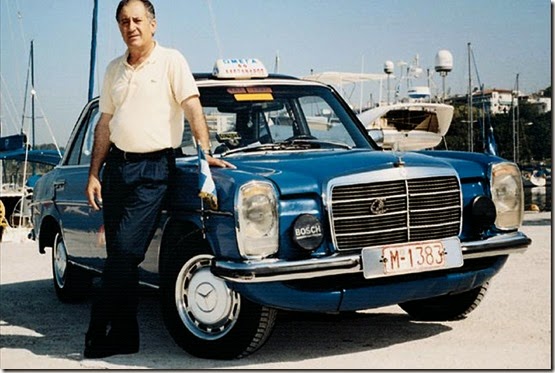
Of course I do not mean to insinuate that Greek Taxi champion Mr. Sachinidis (pictured above) would ever cheat his customers. However, his ability to extract more than five times the expected mileage from his top quality German car (the purchase of which was a major contributor to Greece’s present indebtedness, I should point out) would seem to highly recommend him to the Greek Finance Ministry as a suitable replacement for the hapless Mr. Theocharakis. If the Greeks feel that they now need to haggle like taxi drivers, at least they should send a real one!

While Greece has, to everyone’s surprise, managed to take the April 9 IMF hurdle, its troubles are only beginning, as the chart below makes clear:

image

Postedit April 17: I have now revised this chart by correcting some errors in the Bloomberg source using IMF data. Bloomberg left out the substantial repayments to the IMF on May 1 and 12, and used an incorrect SDR/€ conversion for the June 12 payment.

Wednesday, April 1, 2015

Grexit, Graccident, Grone…

Going going gone Hull Daily Mail

Is the Eurozone sleepwalking its way to disaster, or is there method in this madness?

The Greek debt crisis was supposedly resolved, or better, postponed, for at least four months, on Feb. 20. Instead we now find ourselves this week back to square one, with the Greek government resubmitting vague and insincere “reform” plans while the “troika” (now renamed “the institutions”) still insists that the draconian austerity measures agreed with the previous Samaras government be implemented to the letter (or, as German Chancellor Merkel now allows, up to some cosmetic reshuffling that is fiscally neutral, i.e., equally contractionary). Meanwhile, the Greek government is playing the Russian card, something I facetiously recommended to it in my Feb. 15 post. This will undoubtedly endear it even more to its Western allies.

The Greek debt crisis has now been playing out for five years and things have only gone from bad to worse (with the Greek debt ratio rising from 110% to 170% and unemployment stuck at 25%). Almost all economists agree that nominal Greek debt is unsustainable (even if on a net present value calculation it may be considerably more modest), and that growth will not resume until it is convincingly restructured. No package of “structural reforms” (many of which will actually be inimical to growth, at least in the short term) is going to change this, however reasonable many of these measures may be (and at least the reasonable ones should have been implemented before Greece joined the Eurozone). Both Paul de Grauwe and Michael Pettis have recently argued that addressing such structural issues cannot in itself be a substitute for demand management and debt restructuring. A cynic might even claim that they are indeed just fig leaves for punishing internal devaluation and debt deflation.

So what is going on here? Is the Eurozone just trying to vindicate Einstein’s purported definition of stupidity as "doing the same thing over and over again and expecting different results"? Are the actors even negotiating in good faith?

While Martin Wolf in today’s Financial Times still thinks that a Graccident can be avoided, I now conjecture that both “the institutions” and “the Greek government” have already moved well beyond this point. Having previously played a game of chicken with each other (see here for a nice game-theoretic definition), they are now playing a game of turkey: both parties, having now realized that the worst-case scenario (Grexit) in which neither can back down because losing face is even more painful, is now inevitable, all they care about is shoving responsibility for the ensuing disaster onto their opponents. Germany cannot back down because loosening the “bailout” terms for Greece will only encourage populist parties in Spain (Podemos), Portugal and perhaps Ireland to agitate for the same. And the current Syriza government in Greece, in abjectly surrendering to “the institutions’” old terms as the latter still insist, would have no other honorable course than to return its mandate. But no one wants to be left holding the bag.

Already ECB President Draghi has made known that he does not want to be the odd man out responsible for Grexit by withholding refinancing from Greek banks (something he is already doing)—it has to be an elected official. But neither Merkel nor Juncker nor Dijsselbloem is willing to step up to the plate and force Greece out (thereby possibly initiating the process of Euro unraveling). It has to be a desperate Greek government itself that cuts the ties and starts printing new Drachma to keep paying salaries this month (not to mention the April 9 IMF loan repayment it can never meet without access to the last bailout tranche overdue since Feb. 28). However, if the Greek government unilaterally takes responsibility for cutting loose now, they logically should have campaigned for leaving the Euro, devaluing and defaulting from the beginning (Varoufakis’s infamous middle finger strategy) instead of promoting their illusionary platform of both staying in the Euro and ending austerity. They will be discredited with their electorate and have lost all legitimacy.

So who winds up taking responsibility and getting egg on their face is anyone’s guess. But my bet is that Greece, one way or another, will be out of the Euro by April 9: going going Grone. Kicking the bailout can down the road again with shambolic name games has simply become too ridiculous even for the well-practiced Eurozone.

TURKEYSweb

Has the Greek debt crisis morphed from a game of chicken into a game of turkey?

Sunday, February 15, 2015

Disagreeing to Disagree in the Greek Debt Crisis, or Redeeming Klotzky’s ‘Goold’ (Who Says History is Bunk, Part 5)

On the eve of the probably decisive meeting on whether Greece remains in the Eurozone (Grexit) some reflections seem in order on the nature of international debt negotiations. As always, some elements of complex dynamics and game theory prove useful, but most of all a study of historical analogies to the few similar historical moments of asymmetrical creditor-debtor brinkmanship again come to our aid (who says history is bunk?). The new Greek finance minister Yanis Varoufakis himself appealed to analogies with the plight of debtor Weimar Germany in the 1930s after his fruitless consultation with his German counterpart Wolfgang Schäuble, now in the enviable creditor’s seat. But I’d like to go even further back in time to the origins of the interwar debt and social crisis, the even more mistrustful negotiations in 1919 between the victorious Western allies and the new Weimar German government that had the sorry task of kitting together the shards of their country left behind by their Imperial German predecessors. We are lucky to have the testimony of an eminently astute first-hand participant/witness of these negotiations, no less than John Maynard Keynes.

The European Union was supposed to put an end to Europe’s twentieth century twin ills: territorial expansion and dysfunctional economic nationalism. They were to be replaced with an international system of the rule of law and mutually beneficial cooperation, eventually ending in some form of political and economic integration superseding the traditional boundaries of national sovereignty.

Instead we now find ourselves in a situation of deja-vu, with Russian revanchism now militarily and propagandistically dismembering the national sovereignty of a Ukraine whose national sovereignty Russia apparently never really accepted (despite the 1994 Budapest Memorandum), much like Nazi Germany’s attitude to interwar Czechoslovakia, while exploiting the disunity and weakness of the Western liberal democracies in a rerun of appeasement. And creditor and debtor nations, in the wake of a world economic crisis, are locked in an antagonistic cul-de-sac that has envisioned no other recourse than self-defeating debt-deflation resulting from austerity and the Euro/Gold Standard, much like the 1930s. All of this has been the subject of many blogs on this site over the years, and all of it seems to come to a head again every time I go to Goa on a working holiday.

With the election of the Syriza government in Greece the Eurozone, slumbering in an illusion of stability due to the willingness of the ECB to finally act as a lender-of-last-resort and implicitly mutualize Eurozone sovereign debt risk, and the stoical willingness of other peripheral countries to endure austerity and one-sided internal devaluation, has come to a critical juncture. A democratic electorate has signaled the end of its willingness to make sacrifices to the creditor countries and their banks that show little or no sign of restoring full employment and essential public services and have, predictably, made their debt load even less sustainable. Greece has always been the weakest link in the fragile structure of the Eurozone risk network, but the populist backlash has been brewing for some time in France, Italy and Spain as well. If the EZ finance ministers think they can face down Greece’s newfound obstreperousness, how will they act when they confront a Marine Le Pen as French president a few years hence?

Schäuble VaroufarkisGerman Finance Minister Wolfgang Schäuble (left) disagreeing to disagree with his gadfly Greek counterpart Finance Minister Yanis Varoufakis (right) Feb. 6 in Berlin. The gulf in sartorial styles is an indicative but imperfect proxy for the gulf separating creditor and debtor philosophies.

Lagarde Varoufakis Credit Oliver Hosiet EPAThe only concession to Greece from the “troika” until now has been IMF Managing Director Christine Lagarde sporting a black leather jacket, demonstrating that at least some creditor representatives can beat Varoufakis at his own sartorial game. This strategic ploy evidently only provoked disgust from Eurogroup Finance Minister President Jeroen Dijsselbloem (far left) at the inconclusive meeting last Wednesday that did not even disagree to disagree. Dijsselbloem and Schäuble shared the Creditanstalt Mellon Memorial Prize in 2013 for the Expeditious Resolution of Banks. (Picture credit EPA)

The essence of the conflict between the new Greek government and the troika is not so much debt forgiveness or restructuring as the freedom to reduce the envisioned primary surplus from 4.5% to something like 1.5% and postpone impending repayments to the IMF and ECB. Already Greece’s debt service is only 1.5% of GDP due to extensions and lenient terms. What Greece suffers from is the miscalculation of its creditors in 2010 about the devastating effect of the imposed budget cuts and tax hikes (on the order of 20%) on the real economy and the social fabric: 25% unemployment (50% youth), termination of health insurance coverage, fire-sale privatizations… And the failure of exports to make up for the slack due to reduced public spending. Paul Krugman’s recent blog on Greece’s multiplier woes reiterates this point.

image

IMF projections of Greek unemployment from program implementation in 2010 (“SBA”) down to the 2013 program evaluation (“Latest”) show the extent to which the fiscal multiplier has been underestimated. (Source: IMF Country Report No. 13/156, June 2013)

The new Greek government’s bargaining position is weak. The ECB has placed limitations on its ability to issue short-term T-bonds. The final bailout tranche on Feb. 28 will not be paid without an agreement, threatening it with insolvency. Its banking system has been denied ECB rediscounting and will have to rely on Greek National Bank emergency liquidity funding, while deposits are evaporating in an incipient bank run. Time is not on its side.

Despite Varoufakis’s academic credentials in game theory, his negotiating strategy has been described by Anatole Kaletsky as ‘playing to lose’:

Varoufakis’s idea of strategy is to hold a gun to his own head, then demand a ransom for not pulling the trigger.

German and European Union policymakers are calling his bluff. As a result, the two sides have become stuck in a passive-aggressive standoff that has made serious negotiation impossible.

However, the bluff they are calling is the unraveling of the whole Eurozone should Greece exit (or be de facto expelled). While German officials have been privately mooting that firewalls are now in place, in contrast to the situation in 2010, to prevent contagion to the next weaker Eurozone members such as Portugal, who really wants to play with this potential Lehman-like fire? Thus the two parties are really locked in a game of chicken in which whoever can project the greater appearance of irrational commitment wins (paradoxically, this is where rational choice theory takes us). And Germany has an incentive to make an example of Greece to deter any other country from similarly attempting to renege on its bailout terms, even if the punishment would be punitive for everyone and Greece claims to be a unique case. Ferdinando Giugliano in the Financial Times argues that such a Carthaginian/Melian solution may be in the offing (making an analogy with the war between Athens and Melos during the Peloponnesian War):

The problem with this strategy, however, is that the other player may choose to build a reputation for toughness. This is what Athens opted for — it laid siege to the island and starved the inhabitants into submission.

However one analyzes this confrontation, it is clear that a European project that was intended to promote cooperation and mutual prosperity has degenerated into a negative sum game of brinkmanship resembling war and reparations more than peace and co-prosperity. The tragedy of the current Greek government is, as Kaletsky puts it, that

Whatever form the surrender takes, Greece will not be the only loser. Proponents of democracy and economic expansion have missed their best chance to outmaneuver Germany and end the self-destructive austerity that Germany has imposed on Europe.


Financial Negotiations Anno 1919

         Louis-Lucien_Klotz   Georges_Clemenceau_1

French Finance Minister Louis-Lucien Klotz (left) and his Premier Georges Clemenceau (right) resisted proposals to allow the defeated Germans to use their gold reserves to purchase desperately needed food imports at the 1919 conference in Spa. The French were counting on these reserves as reparations. (Picture credits Wikicommons)

John Maynard Keynes was a member of the British Treasury delegation to the Supreme Economic Council of the Allied Powers in negotiations with defeated Germany and the subsequent peace negotiations in Paris that set the stage for the turbulent interwar years. His revulsion at the dysfunctional and draconian terms of the Treaty of Versailles led him to publish The Economic Consequences of the Peace in 1919 after resigning from the British delegation. The questions attendant on transferring such large sums between debtor and creditor countries without undermining the world economy continued to influence his thought down to his work on the Bretton Woods Agreement to establish a different foundation for the post-WWII era in 1944.

While The Economic Consequences of the Peace first propelled Keynes into the public’s eye, his experiences in these negotiations found a more intimate record in his essay on the economic advisor of the German delegation with whom he soon established friendly personal ties and shared economic viewpoints, Dr. Carl Melchior, in the 1949 volume Two Memoirs, based on a talk he gave in 1921 before the Bloomsburg Memoir Club. The predicament of the defeated Germans was that after four years of naval blockade they were on the verge of starvation but faced as yet undetermined reparation demands. The new Weimar government had hardly established its legitimacy and confronted putsches from the left and the right. Its army had dissolved, its bargaining power was minimal, and its expectation of being bailed out by American loans was, as Keynes pointed out to them, illusionary since this would require a Congressional vote. Keynes then recounts the scene at the negotiations in Belgian Spa in which French objections vociferously advanced by Finance Minister Louis-Lucien Klotz against allowing Germany to use its gold reserves to purchase food imports came to a dramatic and somewhat ludicrous head:

But Klotz was not yet beaten. He still withheld the gold. The Germans should be allowed to pay in any other way, but not in gold. He had shown, he declared, a very conciliatory spirit and had made great sacrifices, but it was impossible for him to go further without compromising his country’s interests, which (puffing himself out and attempting an appearance of dignity) had been placed in his charge.

Never have I seen the equal of the onslaught with which that poor man was overwhelmed. Do you know Klotz by sight?—a short, plump, heavy-moustached Jew, well groomed, well kept, but with an unsteady, roving eye, and his shoulders a little bent in an instinctive deprecation. Lloyd George had always hated him and despised him; and now saw in a twinkling that he could kill him. Women and children were starving, he cried, and here was M. Klotz prating and prating of his ‘goold’. He lent forward and with a gesture of his hands indicated to everyone the image of a hideous Jew clutching a money bag. His eyes flashed and the words came out with a contempt so violent that he seemed almost to be spitting at him. The anti-Semitism, not far below the surface in such an assemblage as that one, was up in the heart of everyone. Everyone looked at Klotz with a momentary contempt and hatred; the poor man was bent over his seat visibly cowering. We hardly knew what Lloyd George was saying, but the words ‘goold’ and Klotz were repeated, and each time with exaggerated contempt. Then turning, he called on Clemenceau to put a stop to these obstructive tactics, otherwise, he cried, M. Klotz would rank with Lenin and Trotsky among those who had spread Bolshevism in Europe. The Prime Minister ceased. All round the room you could see each one grinning and whispering to his neighbour ‘Klotzky’.

Clemenceau did what he could to save the face of his minister, blustering for a few minutes how his country had been ruined and ravaged; what guarantees had France in return for this?—merely a few pieces of gold, a few securities, which it was now proposed to take from them. In a word, he was being asked to betray his country, and that he refused to do.

But it was really all over, Colonel House had supported the Prime Minister. So now did the Italians, The six Japs had sat, and still sat, silent, rigid and seemingly unapprehending, attendants at the drama of another planet. It was tea-time. Loucheur and I were told to go into the next room to prepare a formula, The gold was to be used after all.

“Melchior: A Defeated Enemy”, in Collected Writings of John Maynard Keynes, vol. X, pp. 422-3.

Klotz later denounced Keynes for vetoing a wartime loan to France to support the franc in a 1924 book, leading to an exchange of newspaper volleys culminating in Klotz’s characterization of Keynes’s

swollen vanity…hypertrophy of self which is akin to megalomania…It is Mr Keynes whom I accused and whom I continue to accuse. I said, and I repeat…that Mr Keynes committed towards France an acte atroce on 19 February 1919, when he assured the triumph of his monetary megalomania, which remains the true cause of the financial catastrophe which has fallen on the whole world.

Collected Writings of JMK, vol. XVI, pp. 413-4, quoted in Gilles Dostaler, 2007, Keynes and His Battles. p. 143.

Keynes for his part had been working since 1916 on a plan to cancel all inter-Allied debt “as being likely to promote the well-being of this country [GB] and the world.” Maintaining and aggravating the debt pyramid created by the war constituted a threat to the survival of capitalism (Dostaler, 143). Will the same be ultimately said of the debt pyramid created by the introduction of the Euro?


Lessons for Greece Today?

What are some lessons for contemporary Greece in its negotiations with the troika one can derive from the 1919 deliberations in Spa that would improve on its present losing strategy?

  • Play the starvation card. It’s hard to deny international lending when women and children are starving in the streets (redundant cleaning women on 80% pay may not be enough).
  • Slander you counterpart finance minister as a craven Jew obsessed with ‘goold’ (‘pound of flesh’). Better yet, get one of his allies to do it for you. This may be less effective today than in 1919, especially if he is a German Protestant in a wheelchair, but it may still be worth a try.
  • Claim that denial of funding and stringent terms will open the gates to political extremism (Bolshevism and Freikorps then, neo-Nazis and populist xenophobes now).
  • Point out that a Greece forced out of the Eurozone would be forced to seek funding from and align itself with Putin’s Russia. But this may be of greater concern to the US than the EU.

Clemenceau had been dissatisfied with his choice of Klotz as finance minister, reportedly complaining that he had placed in the Rue du Rivoli "the only Jew in Europe who understood nothing about money.” Klotz for his part never gave up trying to make Germany pay, down to his death in 1930 after falling into disgrace for passing bad checks.

Will German chancellor Merkel later lament that her finance minister Wolfgang Schäuble was the only schwäbische Hausfrau in Europe who understood nothing about international macroeconomics? Whose repeated insistence that “bailout agreements must always be honored” will go down in history with Klotz’s “goold?”

Schäuble Merkel dpa

What will Chancellor Merkel be thinking when her finance minister Wolfgang Schäuble admits that he had no idea that his counterproductive austerity policies would lead to the breakup of the Eurozone and decades of stagnation and social unrest? (Picture credit DPA)

Friday, November 7, 2014

Greasing the Way for the Merkel-Putin Pact (Or Who Says History is Bunk, Part ?)

Molotov-Ribbentrop

The Molotov-Ribbentrop Pact was all smiles in 1939 (“such methods were part of foreign policy at that time”) until Stalin found himself with his back against the wall in June, 1941.

Vladimir Putin’s recent remarks on the irreproachability of the 1939 Molotov-Ribbentrop Treaty (see also FT.com report) between the Soviet Union and Nazi German (aka the Hitler-Stalin Pact) underscores his desperate drive to reach an accommodation with Germany after the crisis triggered by the annexation of the Crimea and the destabilization of Eastern Ukraine. With the ruble now in free fall, weak oil and gas prices, Western sanctions, and a costly stalemate in the Ukraine, he apparently needs to pull more than a domestic patriotic rabbit out of the hat to prevent disaffection with the souring Russian economy.

Readers of this blog will recall that the Creditanstalt Intelligence Bureau as long ago as March 20 identified the coded olive branch Putin extended to Germany in his Crimean annexation speech. The CIB also identified the goal of this initiative on April 7: a Merkel-Putin Pact restoring lost territory to Germany (Königsberg and Polish Pomerania and Silesia) in exchange for recognition of Russia’s Ukrainian annexations and the guarantee of strategic trade of Russian gas and oil against German machinery and cars.

In a gradual campaign to remove the opprobrium such a pact would incite, Putin has begun to relativize the infamy with which the Molotov-Ribbentrop Pact has hitherto been regarded by both Western and Russian historians. This is all the more astonishing when one recalls that, quite aside from the morality of the secret protocols partitioning Poland, the Soviet Union continued to supply Nazi Germany with the essential raw materials and food it needed to mount surprise attack Operation Barbarossa right up to the end on June 22, 1941, long after the Nazis had begun reneging on their part of the agreement. In Putin’s own words, such methods were part of foreign policy at that time, a statement that may come back to haunt him.

Merkel-Putin DW

Who will be smiling for how long should a Merkel-Putin Pact be in the offing? (Picture source: Deutsche Welle)

Friday, July 18, 2014

The Buck Stops Here (Or: I Shot the Sheriff, But I Didn’t Shoot the Deputy)

Truman_pass-the-buck  Putin-Malaysia-Airlines

Left: US President Harry S. Truman at his White House desk with the famous sign “The Buck Stops Here”* (Image: Wikimedia Commons). Right: Russian President Vladimir Putin and his advisers observing a minute of silence on July 17 for the victims of the MH17 airline disaster in the Eastern Ukraine. No such sign is visible.

July 17, 2014, Vladimir Putin on the MH 17 crash:

“And certainly, the government over whose territory it occurred is responsible for this terrible tragedy.”

June 4, 2007, Vladimir Putin on the extradition of Alexander Litvinenko’s accused murderer Andrei Lugovoy to the UK:

“I have mixed feeling about this particular request. If the people who sent this request to us did not know that the constitution of the Russian Federation prohibits extradition of Russian citizens to foreign states -- if they had not known that, then certainly their level of competence is questionable. If they knew that and still did send that request, then it's only a political PR step. From whatever angle, it's complete nonsense.

Finally, the British authorities have allowed many thieves and terrorists to live in their country, and this is precisely the real danger to British citizens.”

November 24, 2006: Sergei Abeltsev, State Duma member from the LDPR, on the death of FSB defector Alexander Litvinenko in London:

"The deserved punishment reached the traitor. I am confident that this terrible death will be a serious warning to traitors of all colors, wherever they are located: In Russia, they do not pardon treachery. I would recommend citizen Berezovsky to avoid any food at the commemoration for his accomplice Litvinenko."

Oct. 10, 2006, Vladimir Putin on the murder of journalist Anna Politkovskaya:

“… that perhaps because Ms. Politkovskaia held very radical views she did not have a serious influence on the political mood in our country. But she was very well-known in journalistic circles and in human rights circles. And in my opinion murdering such a person certainly does much greater damage from the authorities’ point of view, authorities that she strongly criticized, than her publications ever did. Moreover, we have reliable, consistent information that many people who are hiding from Russian justice have been harbouring the idea that they will use somebody as a victim to create a wave of anti-Russian sentiment in the world.”

In his “self-portrait,” First Person, published in 2000, Vladimir Putin denied categorically that the Russian Secret Service FSB was involved in the 1999 apartment house bombings:

“What?! Blowing up our own apartment buildings? You know, that is really…utter nonsense! It’s totally insane. No one in the Russian special services would be capable of such a crime against his own people.”


* American colloquial expression: The saying "the buck stops here" derives from the slang expression "pass the buck" which means passing the responsibility on to someone else. The latter expression is said to have originated with the game of poker, in which a marker or counter, frequently in frontier days a knife with a buckhorn handle, was used to indicate the person whose turn it was to deal. If the player did not wish to deal he could pass the responsibility by passing the "buck," as the counter came to be called, to the next player.

* Russian military designation: The “Buk” missile system (Russian: "Бук"; beech, /bʊk/) is a family of self-propelled, medium-range surface-to-air missile systems developed by the Soviet Union and its successor state, the Russian Federation.

poker1882egansaloonburnsor-500  buk-launch-1s

American “buck” designates who had responsibility for dealing in a poker game (left). Russian “buk” (beech tree), a sophisticated mobile surface-to-air missile (right).

Monday, June 2, 2014

Nitpicking Piketty Productively. Part I: Real Capital vs. Piketty Asset Wealth

The Piketty bubble still shows no signs of bursting (au contraire: Chris Giles’ rather limp attempt in the Financial Times to turn it into another Reinhart-Rogoff data debacle has given it a new lease on life). Surprisingly, however, a number of rather fundamental and elementary issues have been largely overlooked or mentioned only in passing in the voluminous print and online discussion. Yet these issues bear rather crucially on what Piketty sets out to do in his book, at least in his grander ambitions going beyond the data analysis for which he is professionally known. To a certain extent they vitiate much of his analysis, yet at the same time I think they can be reassembled into a much more interesting analysis of wealth and economic growth than the rather crude one he presents (the infamous r>g).

Reassembling this Humpty Dumpty is what I plan to do in these “Nitpicking Piketty Productively” posts.

Let me start with a simple conceptual issue. Thomas Piketty’s professional core competence is in the analysis of disparate data sources to provide long-term historical overviews of household income and wealth distributions. In this, along with his colleagues Tony Atkinson, Emmanuel Saez and Gabriel Zucman, I think we can safely say we are dealing with the best authorities in an empirical area that is inherently difficult to measure, inconsistent and incomplete, and thus will always be open to debate. Nevertheless, these gentlemen must be credited  with making a valiant effort to fill the gap.

It is when we start to move away from Piketty’s core competences that we increasingly encounter confusion.

The Basic Conceptual Problem

Piketty starts with the fairly well-defined notion of Private Household Wealth (PHW) but ends up conducting the analysis (as his title Capital in the Twenty-First Century pretty much compels him to do) in terms of something not coincidentally reminiscent of Marx, namely Capital. This turns out to be an exercise in bait-and-switch, as Piketty himself can not help being aware as an economist in good standing. And it leads to a completely misleading and inconsistent analysis, at the data, historical and theoretical levels. Robert Solow, in his review in the New Republic, immediately identifies this problem, which should have been obvious to anyone with a background in growth theory, but neglects to examine just how far reaching it turns out to be:

There is a small ambiguity here. Piketty uses “wealth” and “capital” as interchangeable terms. We know how to calculate the wealth of a person or an institution: you add up the value of all its assets and subtract the total of debts. (The values are market prices or, in their absence, some approximation.) The result is net worth or wealth. In English at least, this is often called a person’s or institution’s capital. But “capital” has another, not quite equivalent, meaning: it is a “factor of production,” an essential input into the production process, in the form of factories, machinery, computers, office buildings, or houses (that produce “housing services”). This meaning can diverge from “wealth.” Trivially, there are assets that have value and are part of wealth but do not produce anything: works of art, hoards of precious metals, and so forth. (Paintings hanging in a living room could be said to produce “aesthetic services,” but those are not generally counted in national income.) More significantly, stock market values, the financial counterpart of corporate productive capital, can fluctuate violently, more violently than national income. In a recession, the wealth-income ratio may fall noticeably, although the stock of productive capital, and even its expected future earning power, may have changed very little or not at all. But as long as we stick to longer-run trends, as Piketty generally does, this difficulty can safely be disregarded.

Unfortunately, this difficulty cannot be safely disregarded either in the short or the longer run because it leads to disparities on the order of seven to one in some epochs and divergent trends between the private wealth/income and “real” capital/income ratios. And it totally vitiates Piketty’s rather hapless attempt to draw on standard economic growth theory to explain these ratios. Shame on you, Bob Solow, for not seeing this (and also for using the aggregate neoclassical production function in your growth model)!

Capital vs. Wealth: What the National Accounts Say

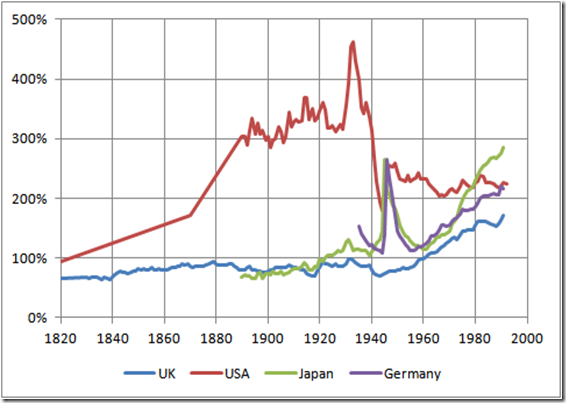
So, how big is this disparity, and how does it evolve over time? Let’s take a quick peek using data on nonresidential capital (equipment and structures) from Maddison (1994, 2003) and on total and nonresidential fixed assets from the US government’s national accounters (Bureau of Economic Analysis—BEA):
image

Fig. I: Nonresidential capital-output ratio for four countries (Source: for nonresidential capital stocks Maddison 1994, Maddison 2003 for pre-1890 USA,), and for GDP Maddison GDP database, all in 1990 Geary-Khemis $).

image

Fig. II: Capital-output ratio in the USA since 1890: 1) using Maddison (1994) nonresidential capital stock estimates and Maddison GDP database as above, 2) BEA nonresidential and 3) BEA total fixed asset estimates (including residential but excluding consumer durable) stocks at current cost, divided by BEA current $ GDP.
image

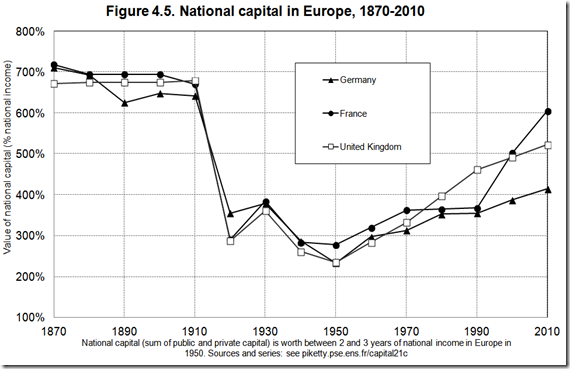
Fig. III: Piketty on the national “capital-output ratio” for Germany, France and the UK.
image

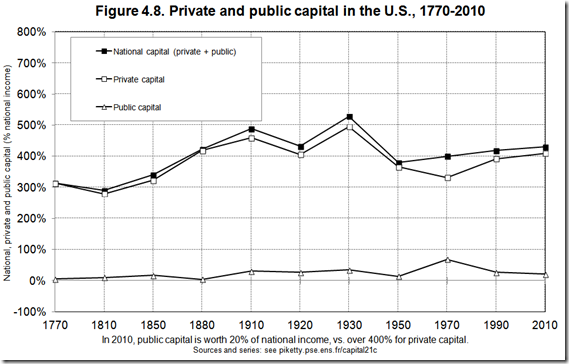
Fig. IV: Piketty on the national and private “capital-output ratio” for the US. Compare with Fig. II.

In our figures I and II capital is being measured by Maddison and the BEA using the perpetual inventory method* applied to gross investment in “real” factors of production—equipment and structures—valued at their current cost at the time of observation. Thus this represents a running account of the forsaken consumption in present prices of the accumulated and still operational investments of the past (on various, possibly questionable, assumptions about the lifetimes, mortality and depreciation rates of these different productive assets) as factors of production. What immediately stands out is that Piketty’s definition of capital for the UK is over seven times larger before 1910, and twice as large (somewhat less if we include residential assets) even for the US after 1950. In Europe, the “real” measure does not display the massive decline between 1910 and 1920 that the Piketty measure does. Moreover, while the “real” capital-output ratio has been systematically increasing after WW2 in the UK, Germany, France, and Japan, it has actually been slowly decreasing in the US from its very high value of over 300% (abstracting from the gyrations during the Great Depression and WW2 due to extreme shifts in the rate of capacity utilization) before 1930 to its present value of around 200%, with the values roughly converging internationally, as one might expect from a theory of technological catch-up. Thus the discrepancies between a national accounts, fixed assets at current costs definition of capital (what I have been calling the “real” capital-output ratio) and Piketty’s is not, as Solow suspected, only a temporary aberration, but in some periods huge and systematic.

Why is this the case? We need to go back to the basics in National Accounting to see why. Capital as defined by Piketty (which I will hereafter denote as Piketty Asset Wealth—PAW) is the net value at current market prices of all long-lived assets capable of generating a monetary return from some combination of annual profits, dividends, rents, interest, pension benefits or capital gains (price appreciation) held by private households, businesses and the state.

Let me break these assets up into seven categories:

  1. Real Producible Productive Capital (RPPC): real produced goods saved from current output, such as equipment and structures, that instead of being consumed are reinvested and live on for longer than a production period to aid in the production of future goods. This is the traditional definition of Capital or Fixed Assets in national accounts and growth theory: machinery and equipment, factories, infrastructure. This will show up as direct ownership of business assets, and indirectly as ownership of equities, stock mutual funds, and claims on pension funds invested in equities. A not inconsiderable part of this is not privately owned (around 15% in the USA) and thus will not show up in private PAW. At one time even slaves fell into this category, but after emancipation magically disappeared from the capital accounts and reverted to being free labor (without compensation to their former owners in the US, but with a large compensatory debt burden for emancipated serfs in Czarist Russia). 
  2. Intangible Producible Productive Capital (IPPC): technology, knowhow, patents, intellectual property, copyrights, human capital (skills, training, education), which are also “produced” by current output, accumulated, and aid in future production but only very incompletely show up in national accounts as capital (the recent redefinition of R&D as investment will start to change this) or in personal balance sheets as wealth. They may show up in PAW in the higher market value of equities than book value (Tobin’s q), the net present value of licenses and royalties.
  3. Real Producible Consumption Capital (RPCC): primarily housing, whether owner occupied or rented, and durable consumer goods (cars, furniture, appliances…) . Statisticians are undecided about whether to lump this with RPPC, so they usually break these items out in fixed assets accounting. But they certainly belong in PAW to the extent that they are privately owned and traded.
  4. Real Nonproducible Productive Capital (RNPC): land and natural resources, to the extent that there is private tradable property in them. The value of these assets in PHW will very much be a function of tax assessment practices, accounting conventions, and the vagaries of their respective markets. These assets are factors of production (but does anyone remember when land fell out of the neoclassical production function?) but are not themselves produced—they are gifts of nature or natural capital—and thus are not accumulated from previous output due to investment. They produce income to their owners according to the Ricardian theory of rent (to the extent that there is free marginal land to define their productive contribution). In preindustrial societies this was the largest portion of wealth and is still by no means a quantité négligeable.
  5. The Net Credit Balance of private households of debt instruments against other households, sectors or countries (NCB): monetary assets (domestic and foreign government and corporate bonds, annuities, funded pension claims, personal IOUs, cash and bank deposits) minus monetary liabilities (outstanding mortgages, consumer loans, etc.). While this will show up negatively and positively in PAW for individual households, averaged over all sectors (household, government, corporate) and countries it will sum to zero and thus represent no net wealth at all (nor any real assets, though it may have been used to finance real asset creation)! Cash is something of an anomaly here, since it does not show up as a liability on anyone’s books, although in some sense it is just as much a component of the national debt as government bonds (and as such just “worthless” printed paper whose value is entirely socially constructed). And while some (mostly poorer) households will have negative NCBs, the private household sector as a whole will be in positive balance as the net ultimate holders of government and corporate debt. In periods of high national debt (e.g., after wars), this can represent a substantial contribution to private PAW but has no effect on “capital” at all. 
  6. Robber Baron Capital (RBC): certain entities will sometimes be privileged with chokeholds on strategic economic activities enabling them to collect super-rents (like the original robber barons on the Rhine who could descend from their impregnable castles perched on otherwise worthless cliffs to lay a chain across the river and collect tolls from passing ships). To the extent that these privileges are salable or inheritable they become priceable wealth. I conjecture that the higher the concentration of wealth and power and the weaker the representation of the volonté générale and the greater the social disorder, the easier it will be for some individuals to establish such chokeholds at the expense of the general welfare (what economists call rent seeking). Patents are a socially sanctioned form of RBC, but otherwise most states have abrogated the right to levy internal tolls (called taxes) increasingly to themselves and abolished other royal privileges and monopolies, and by internalizing this function now have acquired an incentive to promote overall economic activity rather than be purely parasitical on it (cf. Morris 2014). The recent rise of the share of the financial services sector in some countries raises the question of whether this represents a new form of rent extraction or a return for a competitively priced legitimate service to society. 
  7. Real Semiproducible Nonproductive Capital (RSNC): antiques, art masterpieces, precious stones and metals, classic cars, bitcoins, held primarily for their return rather than enjoyment. Things of tradable value that might once have been produced but are now in highly inelastic supply, whose value derives precisely from their verifiable uniqueness and scarcity, and whose rate of return is determined solely by capital gains (price appreciation).

Sorry to bore you will this dry stuff, but only category 1 (RPPC) is what Marx and growth theorists like Solow originally called capital subject to the laws of accumulation, and category 2 (IPPC) is what modern growth theorists would now throw in as an additional capital-like factor of production.

Typology of Asset Categories

Asset Type

Produced

Productive

(Autocatalytically) Accumulated

Source of Returns

Depreciation

1. RPPC (equipment & structures)

yes

yes

yes

factor of production

yes (wear and tear, tech. obsolescence)

2. IPPC (patents, knowhow, skills, education)

yes

yes

yes

factor of production

yes (tech. obsolescence, patent expiration)

3. RPCC (residential housing, consumer durables)

yes

? (rental income would have to be imputed to owner-occupiers)

yes, but not autocatalytically

factor of consumption

yes (wear and tear, tech. obsolescence, fashion effects)

4. RNPC (land, natural resources)

no

yes

no

factor of production, pure Ricardian rent

yes and no (erosion, soil exhaustion, mineral depletion, urban/infrastructure valuation externalities)

5. NCB (deposits, bonds, mortgages, derivatives)

no

no

possibly

pure time preference, risk allowance

possibly (unanticipated inflation on non-indexed debt instruments)

5.1 Funded pension and life insurance claims

no

no

yes

contractual claim on equity and bond funds

expires on death, heritable only to spouse/beneficiary, limited tradability

6. RBC (political influence, market power)

no

no

possibly

pure superrent based on market and political power

? (legal reforms, change of regime, expropriation)

7. RSNC (art, precious metals/stones, bitcoins)

produced but irreproducible; authenticated as unique

no

yes, but not autocatalytically

pure capital gains

no except for storage costs (often a hedge against inflation)

The theory of economic growth is based on the notion that some part of real output is saved and invested to maintain the factor of production capital and contribute physically to future production. It is not a theory of financial stocks and flows. As Keynes reminds us, the act of hoarding money is not the same thing as the act of investing real resources. Thus it only encompasses assets that satisfy all three criteria: produced, productive, and accumulated. The only assets fitting this bill are RPPC and IPPC, with RPCC (residential housing) being a marginal case. Land and natural resources, although productive factors in their own right, are neither produced nor accumulated (abstracting from land reclamation, conquest, and prospecting), and thus not capital in this sense. The income they generate is Ricardian rent. The other asset categories can certainly be income generating, and thus in a balance-sheet sense wealth, but are not capital strictly speaking in the sense of growth theory. It is the sum of (3)+4+5+6+7 that explains the gap between Maddison/BEA capital and Piketty capital. This is not to say that Piketty capital is not a valid object of study. The question is rather, whether its study is amenable to the application of the tools of growth theory. The answer, unfortunately, is no. I shall argue that asset wealth in the categories 3-7 belong to the “claimosphere,” not the “real” economy. That is, they represent marketable, legally sanctioned claims of various types on future income streams, not wealth in the sense of presently existing real factors of production (RNPC, i.e., titles to land and natural resources, being an exception). Thus their valuations and returns must be derived from a different theory than the theory of economic growth, although ultimately they must be consistent with it in the sense that these claims must be reconciled when they come due with the output that is eventually produced and the other claims on it (e.g., from labor and taxation).

ß = s/g is a Capital Mistake in the Discussion of Wealth

In Chapter 5 Piketty makes much of the Harrod-Domar steady-state growth condition ß = s/g, where ß is the capital-output ratio, s is the savings rate, and g is the rate of growth of real output (and equals the rate of growth of the labor force + the rate of labor productivity growth). This relationship is easily derivable from the national accounting identity over time and applies to any growth steady state ex post, regardless of the assumptions about savings, production functions, prices, and technological change, not only under the very restrictive assumptions Harrod and Domar originally imposed (and thus also to the canonical Solow model). But the derivation makes clear that capital only consists of “real” capital, i.e., something that is produced in the economic process, is capable of accumulation, and in turn enters into production as a production factor but lasts longer than a production period. This reduces capital to RPPC and possibly IPPC, but excludes land (RNPC) and all of the other assets enumerated above. Moreover, if we allow for the fact that “real” capital has a finite lifetime by using exponential depreciation at rate d (the perpetual inventory method national statistical agencies actually use allows for a more complex profile of capital survival and valuation differing for each asset type), then the correct formula is

ß = s/(g+d),

a discrepancy several critics of Piketty have already pointed out (e.g., James Hamilton). Moreover, this capital has to be valued in terms of the foregone contemporaneous consumption at current producer prices it represents, not expectations about its future earning capacity that determine asset values in financial markets.

Thus the Harrod-Domar condition only tells us something about the real capital-output ratio but nothing whatsoever about the Piketty Asset Wealth/output ratio (except to the extent that real capital is a component, though not always even a very large one, of historical PAW). It is completely irrelevant to the determination of PAW, as is clear when we consider agrarian societies where land is the main component of wealth but is not accumulated and produced capital, or national debt, which, while not part of national wealth, is a significant component of private wealth. What does determine PAW is a question we shall approach in subsequent posts.

Moreover, Piketty seems to implicitly regard s and g as exogenous factors determining ß, while one could perhaps more plausibly regard ß and g (not to forget d!), at least in mature economies like the US, as determined by technology, demographics, and structural change, and the savings rate, and thus the rate of investment required for steady-state full employment, as the dependent variable rather than exogenously given.

To his credit, Piketty recognizes on page 168 that the Harrod-Domar condition does not apply to nonaccumulable “capital,” i.e. land and natural resources. But it also fails to apply to nonproduced and nonproductive assets as well, which, as we descend from national wealth to private wealth to the private wealth of the 10%, 1%, 0.1% etc., become increasingly large components, as his own data show, in the form of bonds and other financial instruments, real estate, art, etc. And this discrepancy is not insignificant and not temporary due to occasional market aberrations, but systemic.

I don’t want to demean Piketty’s contribution to the debate about income and wealth inequality. But before we carefully dissect what constitutes asset income and wealth, we cannot hope to understand how it has changed over the centuries. A simple-minded invocation of the theory of economic growth à la Harrod-Domar or Solow can be very misleading way of proceeding. An additional observation will be needed to understand the various historical patterns of wealth: that the concentration of wealth is itself wealth generating—not in the sense of generating any real resources (in fact, concentrated wealth may utilize resources less efficiently), but in raising the valuation and returns of certain asset classes (land, shares, financial trading, fine art, and especially robber-baron capital) relative to the general price level and the returns of other economic activities, and thus shifting national income to capital—i.e., by pure asset bootstrapping.

* The perpetual inventory method has problems of its own that make it only a rough benchmark for estimating the capital stock. Its only input is gross investment in each year in different categories of capital goods, and various simplifying assumptions about the survival and lifetimes of these goods need to be made that are not always supported in detail by empirical studies or theories of investment behavior. Nevertheless, it represents the only consistent estimation of real capital based available since national accounts have been undertaken (the alternative censuses of machinery in which equipment and structures are directly canvased by observers have only rarely been performed).

References

A. Maddison, 1994, “Standardised Estimates of Fixed Capital Stock: A Six Country Comparison,” Research Memorandum 570 (GD-9), Groningen Growth and Development Centre (online copy. Table 7a for France is unfortunately missing from this version).

A. Maddison, 2003, “Growth Accounts, Technological Change, and the Role of Energy in Western Growth,” in Economia e Energia, secc.XIII-XVIII, Istituto Internazionale di Storia Economica “F. Datini” Prato, Le Monnier, Florence, April (online copy).

Postedit (June 29, 2014)

As a check on the surprising low values of the Maddison nonresidential capital-output ratio for the UK before WW2 (see Fig. I above) I present data from R.C.O. Matthews, C. H. Feinstein, J. C. Odling-Smee, British Economic Growth, 1856-1973, Stanford University Press, 1982, p. 133 (Table 5.4), on UK Gross Fixed Asset Accumulation 1856-1973. These estimates differ from Maddison’s by including residential housing (which we know to be on the order of 100% of GDP in the US—see Fig. II above) but neglecting depreciation (while allowing for replacement due to finite lifetimes).

While these estimates make the UK domestic fixed-asset capital-output ratio more comparable to that of the US pre-WW2, they are still about half of Piketty’s “national capital” estimates pre-WW1 for the UK, but somewhat higher than his for the period 1920-1960! (Thanks to Alessandro Nuvolari for bringing these data to my attention.)

image

Fig. V: UK gross domestic fixed-asset capital-output estimates 1856-1973 (including residential housing but excluding depreciation; period midpoints plotted). Source: Matthews et al.,1982, British Economic Growth, 1856-1973.